The case for OpenTelemetry maintainership
I believe OpenTelemetry’s primary constraint isn’t ideas, code contributions, or adoption, but maintainers.
I’ve been working on OpenTelemetry since early 2021. I’m a maintainer of opentelemetry-java, opentelemetry-configuration, and opentelemetry-injector, and a member of the Technical Committee. In that time I’ve worked at two observability companies, New Relic and now Grafana Labs, in roles with a charter to work on OpenTelemetry while also engaging in internal engineering efforts that depend on it. This post is my opinion, informed by involvement in a lot of different OpenTelemetry projects and by watching various contributors come and go.
Maintainers do the unglamorous, continuous work that keeps the project running: releases, triage, issue and pull request review, security advisories, mentoring, maintaining user trust, and more. Every contribution matters, but maintainers are the connective tissue that makes the rest possible. Without maintainers, other contributions will never be shipped.
OpenTelemetry has grown in nearly every dimension: contributors, contributions, repositories, adoption. The maintainer pool hasn’t kept pace. If you’ve ever waited weeks for a review, you’ve felt this.
Measuring this cleanly is hard because of confounding factors: a lack of data for maintainership over time, large numbers of automated PRs (e.g., Renovate, Dependabot) and reviews which distort the data, and maintainer burden not being shared equally. I pulled all PR and review data for OpenTelemetry repositories since 2024 and analyzed it. I found that, probably to nobody’s surprise, starting in early 2026, growth in incoming PRs began outpacing growth in engaged reviewers (my proxy for maintainer capacity). From September 2024 to September 2026, the incoming PR / reviewer ratio has grown by 56%.
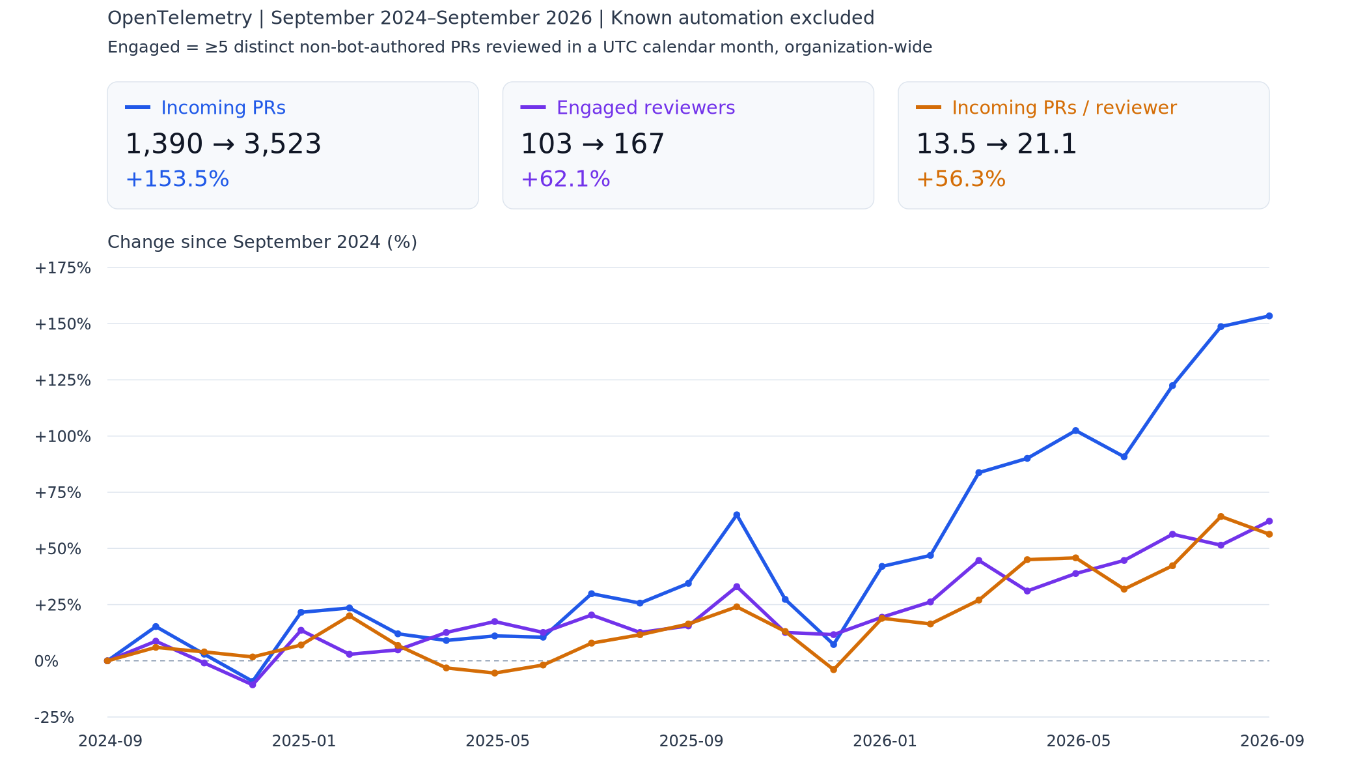
| Measure | September 2024 | September 2026 | Change |
|---|---|---|---|
| Incoming PRs | 1,390 | 3,523 | +153.5% |
| Engaged reviewers | 103 | 167 | +62.1% |
| Incoming PRs per engaged reviewer | 13.50 | 21.10 | +56.3% |
Similar points were made in a recent blog post OTel Isn’t Going Well (And I Made A Spreadsheet About It), but in more detail and for specific areas of OpenTelemetry.
Here, I’ll make the case for why you should consider becoming a maintainer, and why the companies that depend on OpenTelemetry should support you doing so.
Virtuous and vicious cycles
People often complain about the pace of OpenTelemetry. It’s been described as a high-throughput, high-latency project: a lot gets done, but individual workstreams can take a long time. But OSS and OpenTelemetry are not inherently slow. I’ve seen parts of the project move extremely fast, and I’ve watched individual repositories swing from fast to slow and back again.
My read is that the biggest factor in whether a repository moves fast or slow is whether it has enough engaged maintainers to keep up with its contribution rate. That’s the difference between a virtuous cycle and a vicious one.
When a repository has enough engaged maintainers:
- Each maintainer has a manageable number of PRs and issues needing their attention, so they can respond promptly without constantly context switching.
- Prompt feedback encourages contributors and makes small, self-contained pull requests practical, since even a stacked sequence lands in a reasonable time. Small pull requests are easy to review, which keeps feedback fast.
- The project ships more and responds to users faster, which grows adoption and attracts more contributors, some of whom become maintainers.
When it doesn’t, whether from too few maintainers or too little engagement:
- Each maintainer has more PRs and issues needing attention than they can keep up with. Constantly context switching between them drains energy and leads to burnout.
- Feedback cycle time on any individual pull request grows as maintainers round-robin through the queue.
- Slow feedback discourages contributors and pushes them toward larger pull requests, since waiting out a long review cycle for each in a sequence of small pull requests is unpalatable.
- Large pull requests are harder to review and increase the cognitive load of context switching. This slows feedback further and discourages would-be maintainers from stepping up. Review load stays high.
Both cycles reinforce themselves. It may only take one or two engaged maintainers to tip a repository from one cycle to the other. And engagement can be fragile, changing quickly with new jobs, shifting priorities, or life events.
Aligning incentives: individuals and companies
If engaged maintainers are a serious lever for project health, it follows that we need more of them. I’ve proposed that the project incentivize maintainership because I think we can do more to encourage it. But there are already good reasons to be a maintainer today, and I haven’t seen them clearly articulated.
This is OSS, so anyone with the interest and skills can contribute and eventually become a maintainer. However, in practice most OpenTelemetry maintainers do the work as part of their day job (as of writing this, more than 75% of maintainers are affiliated with observability vendors by my analysis). Whether that’s good or bad is a separate question, but it is the reality.
If we want more maintainers, the incentives need to work for both individuals and the companies that employ them. Expecting individuals to carry this alone is asking too much.
Aside: Maintainership isn’t all upside for either individuals or companies, but those details are out of scope for this post. Perhaps a future post or another author can elaborate.
Why you should be a maintainer
Career signal. Being a maintainer is good for your career. When a stranger decides whether to hire you, they’re looking for signals that you’ll succeed: where you went to school, where you’ve worked, who recommends you, how you did on a coding challenge. Maintaining a serious OSS project is a strong signal, and it holds up in the age of AI when others have weakened. Doing it well takes deep technical competence and prioritization skills. It also includes people management skills like conflict resolution, all in public and alongside collaborators who often work for competitors. It’s been good for my career1, and for many others too.
Visibility. Maintainers get opportunities that are hard to come by otherwise: CNCF events (e.g. KubeCon, Observability Summit) grant privileges like a dedicated maintainer track, maintainer summit access, and more. Maintainers are invited to speak on podcasts, webinars, and to share their thoughts in other forums as well. The industry network, reputation, and public body of work you develop travels with you, outlasting any single job.
Being part of something bigger. This was my biggest motivation for getting involved in OSS.
A while back, I had a job I poured myself into. My team built some impressive stuff, earned a few patents, and we were proud of what we accomplished. We were building platform capabilities, essential to the business but not what the business was built around. The company never found product-market fit and contracted dramatically: layoffs, pivots, the whole thing. That software is now sitting abandoned on a hard drive somewhere.
I refuse to be apathetic about work that takes up so much of my life, and it kills me that years of it came to nothing because of forces outside my control.
With OSS, if the idea and the execution are good, your software can succeed and be used at massive scale. That’s what motivates me to wake up and try to do good work every day. No software lasts forever, and OpenTelemetry will likely be replaced eventually (hopefully not for decades). But whatever comes next will have been influenced by it (as OpenTelemetry was influenced by its predecessors). Standards projects like OpenTelemetry become a permanent part of software’s lineage. I can’t say the abandoned software I helped build behind closed doors influenced anyone beyond the few dozen engineers who interacted with it.
Why your company should sponsor maintainers
If you’re a manager or a stakeholder weighing whether to fund maintainer time, this is for you.
More effective contributions. Maintainers don’t get special treatment, but they know the codebase and the project’s norms and priorities, they typically have rapport with other maintainers, and know whom to involve to get the context needed for a good decision. This helps them shape proposals that fit the project and avoid dead ends.
Security. Security advisories have surged since LLMs made finding vulnerabilities cheap. Maintainers help triage and fix advisories before they’re public. If you ship OpenTelemetry components in your product or maintain a vendored fork, that head start means mitigation is already in motion when the advisory lands.
Influence. Projects evolve, and not always in the direction you’d choose. If you depend on OpenTelemetry and have no maintainers, you have a much smaller say in where it goes.
Credibility. Customers adopting OpenTelemetry make buying decisions partly based on who they believe understands it best. Maintainers are the clearest proof of that expertise. If a competitor has maintainers and you don’t, they have an advantage.
Shared foundation. As OpenTelemetry grows, it’s increasingly hard to justify investing in proprietary instrumentation. OpenTelemetry is becoming the shared foundation of every observability vendor’s story, and a weak foundation weakens every story built on it. If every company waits for others to sustain that foundation, repositories slide into the vicious cycle, and the features and fixes your product depends on arrive slowly for everyone.
Becoming a maintainer
If I’ve convinced you, the natural next questions are what it takes and where to start.
At a repository level, the contributor ladder runs from member → triager → approver → maintainer. Different SIGs have their own norms for progression.
What maintainers look for
In my experience, getting invited to be a maintainer is conceptually straightforward (which is not to say it’s easy): exercise good judgment, and show up consistently with an ownership mentality.
Exercise good judgment. The project puts a lot of trust in maintainers. They can merge code and publish releases that end up in many production systems. Existing maintainers want to extend that trust to people with good judgment. In practice, that means all the classic software engineering stuff, including understanding what you’re proposing and its tradeoffs. But in OSS, soft skills carry particular weight. Consider other perspectives and follow through on feedback. Help discussions move forward by summarizing points of agreement and disagreement, identifying missing information or pending decisions that block progress, and breaking proposals into smaller steps that can proceed independently.
Show up consistently. How much time maintainership takes varies with the project’s size, maturity, and so on. Whatever the total, showing up consistently in small chunks is much more useful than showing up in large, infrequent ones. If you have 5 hours a week, 1 hour a day for 5 days beats 5 hours in one day. Showing up week after week gives maintainers confidence that you’ll stick around and share responsibility for the project.
Have an ownership mentality. A maintainer is responsible for every aspect of their project’s lifecycle: build, testing, roadmap, style, documentation, releases, and more. You can and should adopt that mentality before you’re invited. You won’t be able to run releases or merge pull requests, but you can contribute to everything else, especially code review. You don’t need to be an approver or maintainer to review code. Reviews are meaningful from any contributor. This is the behavior existing maintainers look for when deciding whether to invite someone new.
Where to start
Work with what you use and what you need.
OpenTelemetry is a big project, and even a single repository can be daunting. I find the best approach is to start with a piece of the project you already use and know could be better. Watch for issues and pull requests related to it, and review them. Start attending the relevant special interest group (SIG) meetings. Check out proposed changes locally and use them as a forcing function to explore how the subcomponent connects to the rest of the project. As you explore, you’ll come across things that make you raise an eyebrow. Fix them in small, focused pull requests along the way. This builds rapport with maintainers. As you learn more subcomponents, expand the issues and pull requests you watch to include them.
You may be tempted to avoid repositories whose maintainer group already looks crowded. Ignore that instinct. If an area aligns with your interests and maintainership is clearly lacking, that’s a strong signal to get involved. But even groups that look sufficient at first glance may not be. The issue and pull request load may be high enough that a decent-sized group struggles to stay afloat. Some maintainers may be sticking around without the time to commit, because leaving would drop the project below the threshold it needs to function.
When you do make contributions via PRs or issues, be patient, since you may be stepping into a project in one of these vicious cycles. For better or worse, when attention is scarce, stating the case for why a thing matters synchronously in the SIG meeting can be an effective way to gain consensus and make progress.
Aside: The open-telemetry/community repository is a great resource for finding your way around OpenTelemetry. It has SIG meeting schedules and links, plus documentation on roles, responsibilities, and processes.
Takeaways
OpenTelemetry’s primary constraint is maintainers. Repositories with enough engaged maintainers tend to move fast, repositories without them tend to stall, and the difference compounds.
If you’re an engineer working with OpenTelemetry, maintainership is a career goal worth pursuing seriously. If you’re a manager at a company that depends on OpenTelemetry, maintainership is a strategic investment that makes the rest of your OpenTelemetry work more effective. Companies can’t sponsor maintainers without individuals willing to do the work. And individuals usually can’t do the work without a company to sponsor them.
OpenTelemetry is great today, but there’s still a lot of important work ahead. More maintainers means more virtuous cycles, and that’s how the project reaches its potential.
Since getting involved in OpenTelemetry, I have been promoted several times directly as a result of that work. I believe I also have more career mobility than average: I’m frequently targeted by recruiters specifically interested in my OSS background, and have an easy time demonstrating competency through my public OSS contributions. I was a decent engineer before OSS, but I’ve definitely improved my verbal and written communication and my technical skills by working with and observing highly competent engineers. ↩︎