What can you do with OpenTelemetry entity events?
Metrics, logs, and traces tell you how your systems behave. They are much quieter about what actually exists: which hosts, interfaces, switches, services, and volumes are out there right now, and, crucially, how that picture changed over the last hour, day, or quarter. That living inventory has stayed a blind spot in the open observability stack.
OpenTelemetry’s entity events, coming out of the Entities SIG and described in the Entity Data Model, are the piece that starts to close it. Entity events are a stream. The interesting question is “what do I do once they arrive?” This post walks through one answer, using an open source consumer as a worked example.
Note: The entity data model and its conventions are still in development (not yet stable) and evolving — treat the exact attribute names below as illustrative and check them against the current spec. Everything here is about the general shape of consuming entity events; the lessons apply to any consumer.
A 60-second primer on entity events
OpenTelemetry carries entity events as OTLP log records annotated with the
entity semantic conventions. Each event carries the entity’s type, its
identifying attributes, its descriptive attributes, and an event type describing
its lifecycle. A consumer can classify a record purely by the presence of
otel.entity.event.type:
# An entity-event log record (illustrative)
LogRecord
  Timestamp: 2026-05-26T08:00:00Z              # the producer-side time
  attributes:
    otel.entity.event.type: entity_state       # observed; or entity_delete
    otel.entity.type:       host
    otel.entity.id:         { host.name: web-server-1 }            # identity (a map)
    otel.entity.attributes: { os.type: linux, host.arch: amd64 }   # descriptive (a map)
Producers emit these — a host agent, a network agent, anything that speaks OTLP. The consumer’s job is to turn a sequence of such observations into something you can ask questions of. The shape is a pipeline:
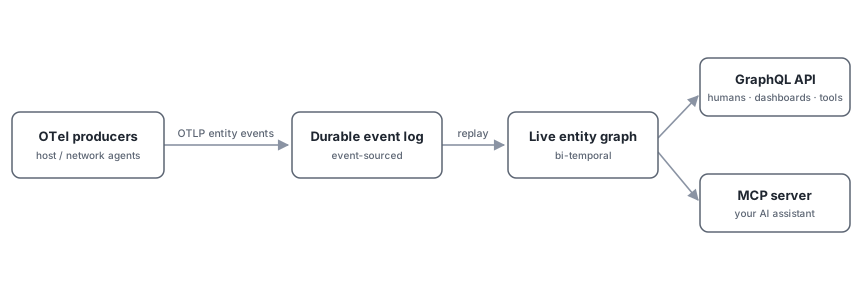
The rest of this post is the four steps in that pipeline.
Step 1 — Don’t store state, store the stream
The instinct is to keep a table of “current entities” and update rows in place.
That throws away exactly what makes infrastructure hard: time. The moment
you overwrite web-server-1’s address, you lose the fact that it changed and
when.
A better default is event sourcing: append every entity event to a durable, ordered log and treat that log as the system of record. The current graph is then a projection — replay the log into an in-memory model of entities and relationships. Rebuilding the whole graph from scratch is just a replay.
The payoff: current state is one read away, and history is never lost.
Step 2 — Be bi-temporal on purpose
Two timestamps matter:
- Event time — when something happened in reality. Take it from the
LogRecordtimestamp. - Recorded time — when you learned about it. Stamp it yourself at ingest; never take it from the producer.
Keeping both lets you answer two genuinely different questions:
- Reality view: “How was
db-07wired last Tuesday?” - Audit view: “What did we know about
db-07at 09:00?”
That second question is the one that matters during an incident review, and you can only answer it if you never collapsed the two timelines. Designing for bi-temporality from day one is far cheaper than retrofitting it.
Step 3 — Give entities an immutable identity
OpenTelemetry treats an entity’s ID as immutable, and that turns out to be the right discipline for a graph that wants to be a source of truth. Match identity exactly: an observation is either a known entity (same ID) or a different one.
The trap is putting a value that changes into the identity. If a host’s identity includes its current leased IP, a DHCP renewal forks it into a brand-new entity. Pick attributes that stay stable for the entity’s lifetime, and let everything that legitimately changes — current address, resource usage, last-seen state — be a descriptive attribute. Then a re-address is an attribute update on the same entity, and a genuine identity change is correctly a new entity rather than a silent merge of two different things.
When a single value is reused over time, the fix isn’t to drop it but to pair it
with a discriminator. OpenTelemetry’s
process entity is a
good model: a PID can be recycled, so a process is identified by process.pid
and process.creation.time together — stable for that process’s lifetime —
while its changing facts stay descriptive.
This is worth getting right early: a “tolerant” match that treats an observation differing by one identifying value as the same entity quietly merges distinct entities — two databases on a host differing only by port collapse into one. For a source of truth, a silent collision is a worse failure than a lost heuristic.
Step 4 — Make it queryable
A temporal graph is only useful if people (and machines) can ask it things. Exposing it twice covers both audiences:
- A GraphQL API for humans, dashboards, and tools.
- A Model Context Protocol (MCP) server so an AI assistant can query the graph on an operator’s behalf.
The MCP angle is where entity events get genuinely fun. Because every type/field/argument carries a rich description, an LLM can introspect the schema and call typed tools — find entities, get neighbors, entity history, recent changes, describe schema — to answer questions in plain language:
$ ask "which switches did db-07 depend on last Tuesday — and what changed since?"

→ db-07 dependency path @ 2026-05-26
    core ← leaf-sw-3, spine-sw-1
  Δ since: leaf-sw-3 → leaf-sw-9 (2026-05-28 14:12 UTC)
    spine path unchanged
No dashboard pivoting; the assistant reasons over a live, time-aware graph that came entirely from OTLP entity events.
Relationships are now in the spec
Inventory is half the story; topology is the other half — “this service depends on that database,” “this process runs on that host.” When this post was first drafted, relationships were still future work; since then the entity-events specification has shipped in the v1.58.0 spec release (2026-06-22) and models them directly — see Entity events (opentelemetry-specification#4836).
Relationships are embedded in an entity’s state event as an
entity.relationships array. Each descriptor names a relationship type and
the target entity (its entity.type and entity.id); direction is
source --[type]--> target, and the types are an open enumeration
(depends_on, contains, …):
# Relationships ride inside an entity-state event (spec #4836, shipped in v1.58.0)
LogRecord
  attributes:
    otel.entity.event.type: entity_state
    otel.entity.type:       service.instance
    otel.entity.id:         { service.instance.id: checkout-1 }
    entity.relationships:
      - type:        depends_on
        entity.type: service.instance
        entity.id:   { service.instance.id: payments-1 }
The edges travel with the entity that owns them, not as separate events: removing a relationship is just the source re-emitting its state without that descriptor. A consumer building a temporal graph reads each state event, upserts the entity, and reconciles its outgoing edges — gaining and losing relationships as the array changes over time, which slots into the same change taxonomy as attribute updates.
Why a graph: it joins your other signals
The point of all this isn’t a standalone inventory — it’s leverage on the telemetry you already have. OpenTelemetry carries entities on the Resource, so the same entities you’re tracking are already attached to your metrics, logs, and traces. The inventory and topology graph becomes the join key across them:
- Scope, not scrape. Use the graph to decide which signals to pull — the entities and the slice of topology you actually care about — instead of querying blindly.
- Correlate by entity. Tie a metric spike, a log line, and a trace to the same host, process, or service because they share an entity identity, not because you hand-matched labels.
- Follow the edges. Relationships (
depends_on,runs_on) turn correlation into blast-radius reasoning: whendb-07degrades, the graph points you at the upstream services whose traces and metrics to look at first.
A live, time-aware graph of what exists and how it connects is what lets you ask those questions of the rest of your observability data — and answer them as of any point in time.
Keep the producer side generic
A consumer should ingest from any OpenTelemetry producer and speak the standard, not a proprietary protocol — it runs no collectors of its own and polls no devices directly. Emitting entity events from hosts, network gear, or cloud APIs is the producers’ job. Keeping the producer side generic is what keeps the ecosystem open.
A few operational notes
A consumer that wants to be a source of truth has to face some realities:
- Clock skew. Event time comes from producers, whose clocks drift relative to each other. Don’t assume a single global order across producers; reason on per-entity timelines, and keep your own recorded time as the tiebreaker for “what did we know, and when.”
- Volume and heartbeats. Producers re-assert entities periodically, so most events say “nothing changed.” Coalesce consecutive unchanged observations (keep the first and last of a run) so steady-state traffic doesn’t balloon the log — while keeping structural changes, like a relationship appearing or disappearing, verbatim.
- Silent merges. The flip side of exact identity: if two distinct entities accidentally share an identifying key, they collapse into one. Treat identity keys as a contract with producers, and prefer failing loudly — a rejected or flagged observation — over a quiet merge.
Takeaways
- Entity events turn “what exists and how it connects” into first-class OpenTelemetry data.
- Consume them as an event-sourced, bi-temporal stream, not a mutable table.
- Treat the entity ID as immutable and match it exactly — put volatile facts in descriptive attributes so history survives change.
- Expose the graph for both humans (GraphQL) and assistants (MCP); the natural-language query story is a strong reason to care.
- Relationships are specified — embedded in each entity’s state event — and shipped in the v1.58.0 spec release.
- Entities ride on the Resource, so the graph is a join key for your existing metrics, logs, and traces.
Get involved
- Read the Entity Data Model and OTEP 0256, then join the conversation in the OpenTelemetry Entities SIG and Semantic Conventions — the entity-events and relationships work shipped in v1.58.0 and is still moving (identity scope and more are in flight).
Thanks to the Entities SIG for the spec work this builds on.