OTel-Arrow Phase 2: From Efficient Transport to Efficient Telemetry Pipelines
Phase 1 of OTel-Arrow established OTAP, the OpenTelemetry Arrow Protocol, as an efficient transport protocol for OpenTelemetry. Apache Arrow is a language-independent, columnar in-memory format designed to move and process structured data efficiently across systems. We demonstrated that telemetry could be transported with significantly lower network overhead while preserving compatibility with the OpenTelemetry data model.
Phase 2 asked a different question: what happens if Arrow is used not only on the wire, but also as the representation the pipeline works with internally?
Telemetry volume is increasing quickly, driven by broader OpenTelemetry adoption, richer instrumentation, and more dynamic AI and agentic workloads. At that scale, common pipeline operations such as removing an attribute, renaming a field, adding metadata, or routing signals should cost as little as possible. Many of these operations are simple and repetitive: if a processor touches an attribute in one record, it will often touch the same attribute across many records in the same batch.
That pattern maps well to a columnar representation. If telemetry can remain in compact Arrow batches while processors rename attributes, enrich data, and route signals, the pipeline can do less work around each transformation and use CPU and memory more efficiently and predictably. We believe OTAP can play an important role in helping OpenTelemetry pipelines handle this next phase of telemetry growth more efficiently.
A Dataflow Engine Built to Test the Arrow Path
To explore this idea, we built the OTel-Arrow Dataflow Engine, a Rust runtime designed around OTAP as the primary in-pipeline representation. It can consume and produce OTAP streams end to end, while also supporting OTLP (OpenTelemetry Protocol) through a separate first-class data path.
This dual-path design lets us compare two modes in the same runtime: an OTAP-direct path that keeps telemetry in Arrow record batches, and an OTLP-compatible path that converts between OTLP and OTAP at explicit boundaries. The result is clear: when telemetry stays on the OTAP path end to end, transport and processing costs drop substantially.
The OpenTelemetry Collector is the broadly deployed, general-purpose implementation for OpenTelemetry pipelines. Its pipeline model is built around OTLP-shaped in-memory data structures, which makes it flexible and closely aligned with the OpenTelemetry data model, but also relatively expensive for high-volume batch processing. The purpose of this work is to test a different design point: a telemetry data plane built around OTAP as the primary data representation, with OTLP compatibility handled at explicit boundaries.
The Dataflow Engine uses a NUMA-friendly, thread-per-core, shared-nothing architecture. It emphasizes bounded channels and data structures, avoids synchronization in hot paths, propagates delivery acknowledgments through pipelines, and supports live pipeline reconfiguration through an admin API.
Our benchmarks compare the cost of two pipeline data representations: the OTLP-shaped object model used by the Collector, and the OTAP representation used by the Dataflow Engine. They also evaluate runtime design choices such as Arrow-based processing, fewer conversion boundaries, bounded execution, and explicit flow control.
In the diagrams below, DFE refers to the OTel-Arrow Dataflow Engine, while Collector refers to the OpenTelemetry Collector implementation.
Benchmark Highlights
The Phase 2 benchmarks were designed to answer three practical questions:
- Does keeping telemetry in an Arrow representation make real pipeline processing less expensive, or does OTAP only help on the wire?
- If so, can the runtime architecture itself sustain and scale that efficiency linearly as more CPU cores are assigned?
- How much additional throughput do OTAP streams provide compared with OTLP streams using the same amount of resources?
The full benchmark matrix is available on the interactive benchmark site. Here we focus on three summary diagrams that capture the most important results. The interactive site provides the complete view, including additional rates, batch sizes, compression settings, memory behavior, network usage, saturation markers, and the test configurations used.
Benchmark Context
The benchmark uses a deliberately simple transformation operation: renaming log
attributes such as exception.type to exception.kind.
This kind of work appears frequently in OpenTelemetry pipelines. Teams rename attributes during semantic convention migrations, normalize fields before sending data to a backend, add environment metadata, or prepare telemetry for routing, governance, and enrichment. Individually, these operations should be inexpensive; and they often are. But the cost is often the surrounding decode, object-walk, allocation, and encode work, not the actual transformation itself.
Most transformation benchmarks were run on an Intel Xeon Platinum 8581C system with 16 cores and 118 GiB of RAM, running Debian GNU/Linux 12; see the interactive benchmark website for full environment details. In these tests, a single core was assigned to the pipeline under test, while the remaining cores were used by the traffic generator and simulated backend. Cores were pinned to keep placement stable and reduce cross-component interference. Scaling and saturation tests used a separate 64-core, 2-socket Intel Xeon 8358 system with 1024 GiB of RAM. See the benchmark documentation for the full experimental setup, including how back-pressure was configured for each tested pipeline.
Result 1: OTAP Keeps Processing Cheap, While Backpressure Bounds Overload
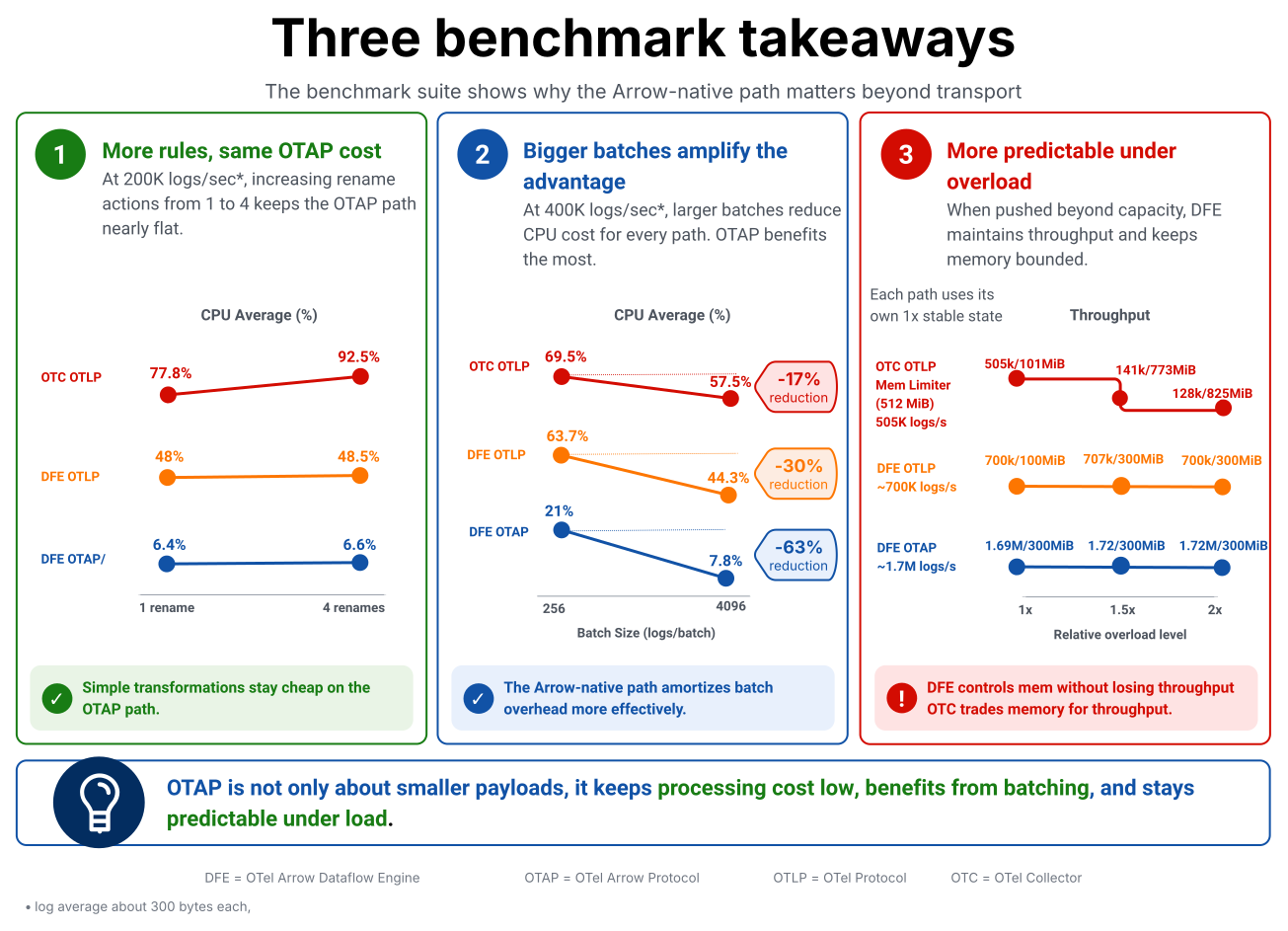
Figure 1: Summary of transformation benchmarks showing sensitivity to the count of transformation rules, batch-size behavior, and overload behavior.
The diagram above summarizes three important observations from the transformation benchmarks.
The first observation shows that adding more rename actions has very little incremental cost on the Dataflow Engine. At 200K logs/sec, with approximately 300 bytes per log entry, the native OTAP path moves from 6.4% to 6.6% CPU as the number of rename actions increases from one to four. The DFE OTLP path is more expensive because telemetry first has to be decoded from OTLP and converted into the OTAP-oriented internal representation, but once that conversion cost is paid, additional rename actions add very little CPU there as well.
The OTel Collector OTLP path represents the current Collector. It pays the high upfront cost of decoding OTLP proto and then a further 3.75% CPU per operation for a total of 92.5% CPU after four operations.
The second observation shows that at 400K logs/sec, larger batches reduce CPU cost for every path, but the OTAP path benefits the most. It drops from 21% CPU at 256 logs per batch to 7.8% at 4096 logs per batch, which is the expected behavior for a compact, columnar, batch-oriented representation.
The third observation is about the engine’s overload behavior. The figure shows the Collector OTLP path with a 512 MiB memory limit, chosen to keep the memory budget in the same range as the Dataflow Engine OTLP path, which uses about 300 MiB in this scenario. With that setting, Collector memory grows sharply under saturation while received throughput drops. Higher Collector memory limits improve received throughput: at 2x saturation, a 2048 MiB limit receives about 544K logs/sec versus about 128K logs/sec with a 512 MiB limit, but average memory rises to about 1.3 GiB. The higher limit lets the Collector keep more work in memory while CPU is saturated, which improves received throughput but shifts more of the overload cost into memory usage. The Dataflow Engine keeps memory bounded even when overloaded as it applies backpressure, making overload visible instead of letting memory absorb it.
Taken together, these results show two complementary effects: OTAP keeps processing cost low and benefits significantly from batching, while the Dataflow Engine’s bounded execution model makes overload behavior more predictable by applying backpressure.
The next two results separate two questions: first, whether the Dataflow Engine runtime scales when telemetry enters through OTLP, and second, how much more throughput is available when the same runtime can stay on the native OTAP path.
Result 2: Scaling Stays Close to Linear
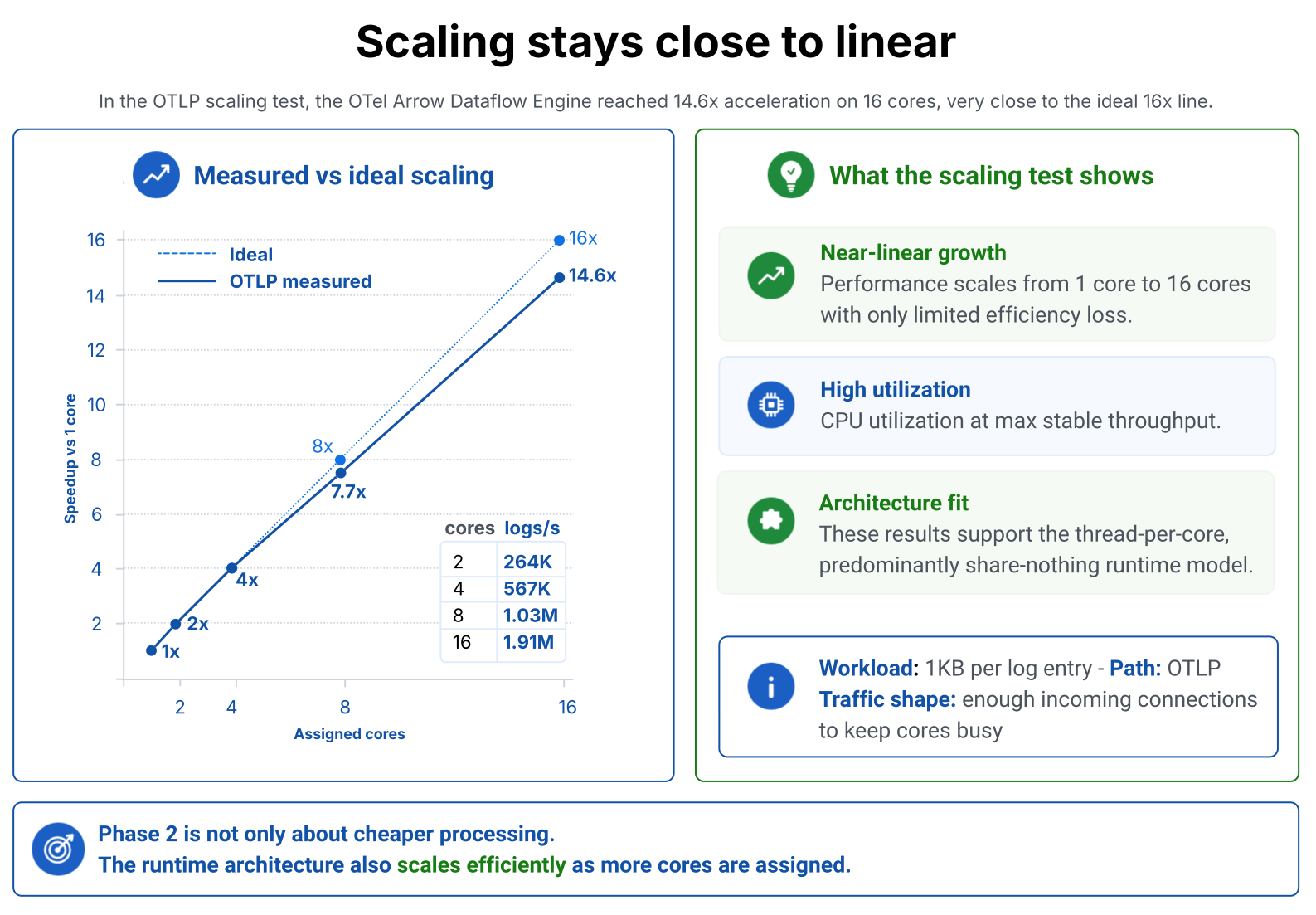
Figure 2: OTLP scaling test comparing measured speedup with ideal linear scaling from 1 to 16 cores.
The second diagram demonstrates how well the Dataflow Engine uses available CPU cores. The thread-per-core, shared-nothing architecture avoids synchronization primitives in hot paths, so additional cores translate into additional throughput with minimal coordination overhead. In this test, telemetry enters as OTLP, meaning each batch must be decoded and converted before processing — a deliberate choice to show scaling under realistic conversion cost rather than an ideal Arrow-only workload. Even so, the engine reaches 14.6x speedup on 16 cores, close to the ideal 16x line, and 1.91M logs/sec overall. If a single core handles throughput N, sixteen cores deliver close to 16N. For operators, this means vertical scaling is effective — a benefit that complements the horizontal scaling most pipelines already rely on.
This result separates the runtime question from the protocol question. In this test, telemetry enters as OTLP and must be decoded and converted before processing can happen. Even with that conversion cost, the thread-per-core, shared-nothing architecture with bounded flow control is able to use the assigned CPU cores effectively. For operators, the practical result is vertical scaling: more cores translate into more throughput with limited efficiency loss.
Result 3: OTAP Provides Higher Throughput on the Same Runtime
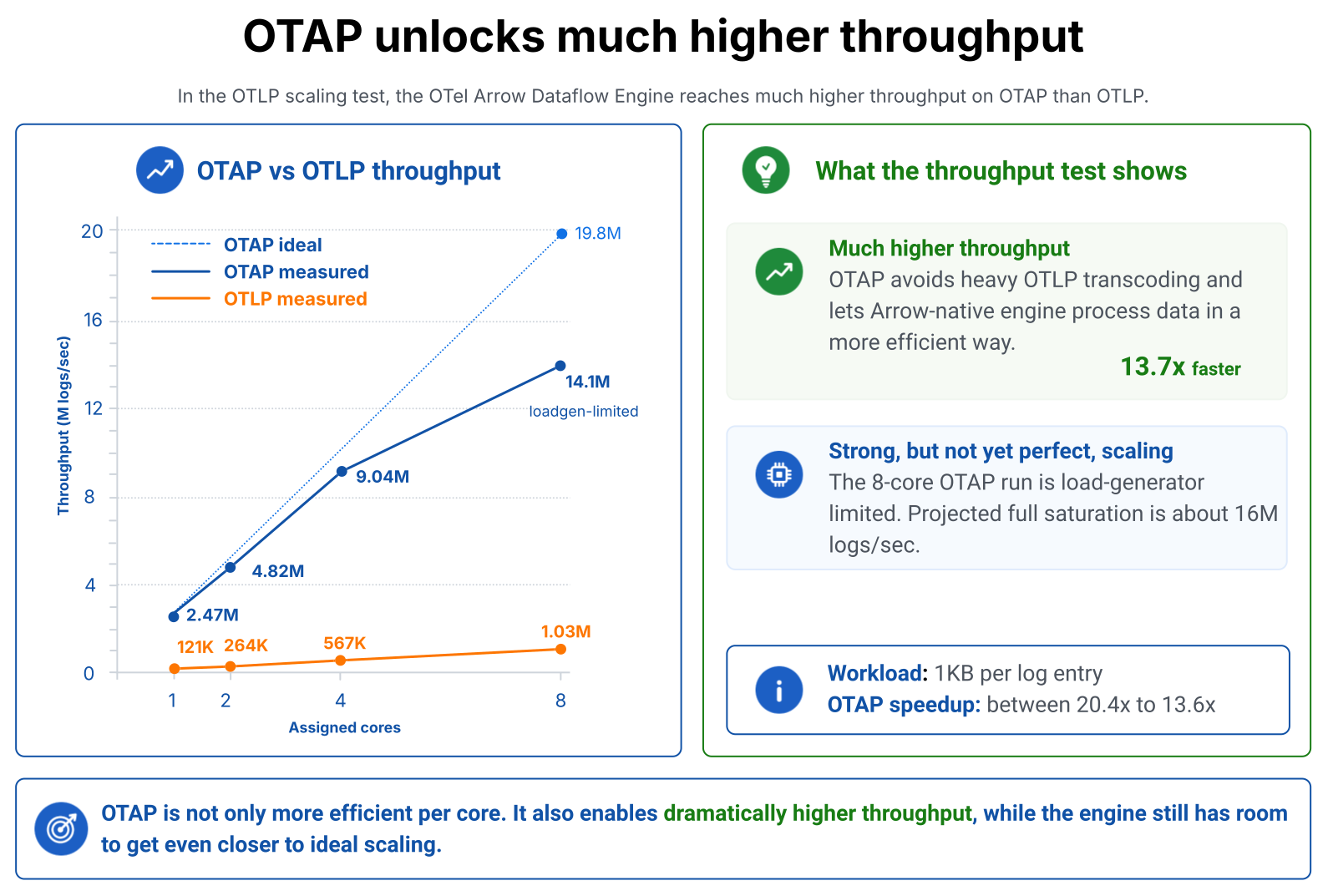
Figure 3: Throughput comparison between OTAP and OTLP paths on the OTel-Arrow Dataflow Engine.
The third diagram compares OTAP and OTLP throughput on the same Dataflow Engine, using the same number of cores. When both input and output are OTAP, the engine pays no conversion cost - telemetry stays in its Arrow-native representation from ingestion through processing to export. When input is OTLP, the engine must decode and convert each batch before processing, and convert back on the way out. That conversion boundary is the entire difference between the two paths, and removing it gives the OTAP path roughly 10 to 20 times the throughput of the OTLP path, depending on core count, on the same runtime. At 1 core, the OTAP path reaches 2.47M logs/sec while the OTLP path reaches 121K logs/sec, a little over 20x.
This result shows the effect of removing the OTLP conversion boundary. OTAP avoids heavy OTLP transcoding and lets the Arrow-native engine process data more directly. The 8-core OTAP run is load-generator limited, and the projected full-saturation throughput is about 16M logs/sec, so there is still room to move closer to ideal scaling.
Key Takeaways
These three benchmark summaries support the main direction of Phase 2. OTAP reduces the cost of representing telemetry. The OTel-Arrow Dataflow Engine preserves that advantage through processing, scales it across cores, and keeps overload behavior visible and contained. For production telemetry pipelines, that predictability matters as much as raw throughput. OTAP is not only cheaper per operation; it also enables much higher throughput on the same hardware.
These comparisons should be read as measurements of the specific benchmark paths and configurations shown here, not as universal claims about every possible Collector deployment. The full benchmark matrix is available on the interactive benchmark site for readers who want to explore the raw charts and configuration details.
Why Arrow Changes the Cost Model
The benchmark results are not only about avoiding serialization. They show a deeper change in the cost model of telemetry processing.
In a row-oriented, OTLP-based path, telemetry arrives as protobuf bytes. Decoding those bytes materializes each telemetry record as a heap-allocated object graph spanning resource, scope, and individual signal records. A processor walks and modifies those objects, and re-encoding converts the result back to bytes. Every allocation on the way in becomes garbage on the way out. For batch-uniform operations such as attribute renames, that allocation and collection pressure can outweigh the transformation itself. This is a structural cost of row-oriented processing, independent of any particular implementation.
With an OTAP-native path, telemetry can remain in Arrow record batches. Processors can operate on a compact, columnar, batch-oriented representation, with better memory locality and fewer allocations. Repeated values are grouped more naturally, compression has a more favorable layout to work with, and processors can take advantage of Arrow kernels, dictionary encodings, or vectorized execution where the operation fits the columnar model.
In short, OTAP does not only reduce the number of bytes on the network. Its larger opportunity is to reduce overhead inside the telemetry data plane itself.
Current Maturity Level
The OTel-Arrow Dataflow Engine has reached a maturity level where many essential capabilities are usable in realistic environments. It is still more accurate, however, to describe it as an incubation-stage project than as a production-stabilized platform for external users.
The project is still evolving, including configuration formats, APIs, component interfaces, and operational semantics. At this stage, there is no stability or backward-compatibility guarantee for those surfaces.
Users should treat the engine as something to evaluate, benchmark, and shape through feedback. Real-world usage should be limited to controlled experiments; production workloads are not recommended at this stage.
Conclusion
OTAP is not simply a more compact network format. When telemetry remains inside an Apache Arrow data model through transport and pipeline processing, the pipeline can avoid repeated deserialization, object reconstruction, allocations, copies, and reserialization, while opening the door to vectorized processing and higher compression ratios.
Combined with an architecture grounded in bounded runtime design, this representation enables gains across multiple dimensions: network efficiency, CPU consumption, memory usage, stability under load, and controlled reconfiguration. That is why we believe the Arrow-native path is an important direction for OpenTelemetry as telemetry volumes continue to grow and observability pipelines are expected to perform more work before data reaches the backend.
We would particularly welcome feedback from the OpenTelemetry community around runtime semantics, operational models, processing APIs, pipeline guarantees, and OTAP-native processing patterns. We are also interested in benchmark ideas, real-world pipeline designs, and configurations that significantly improve throughput, efficiency, memory behavior, or overload handling. We would like to use them to challenge our assumptions and raise the performance and scalability bar for telemetry pipelines.
Join the discussions in the otel-arrow GitHub project, on the #otel-arrow Slack channel, or in the relevant OpenTelemetry SIG meetings - Arrow. Contributions are welcome. For larger contributions, we strongly encourage opening a GitHub issue before beginning implementation work and using SIG discussions for early feedback when the change affects architecture, semantics, or broader ecosystem integration.